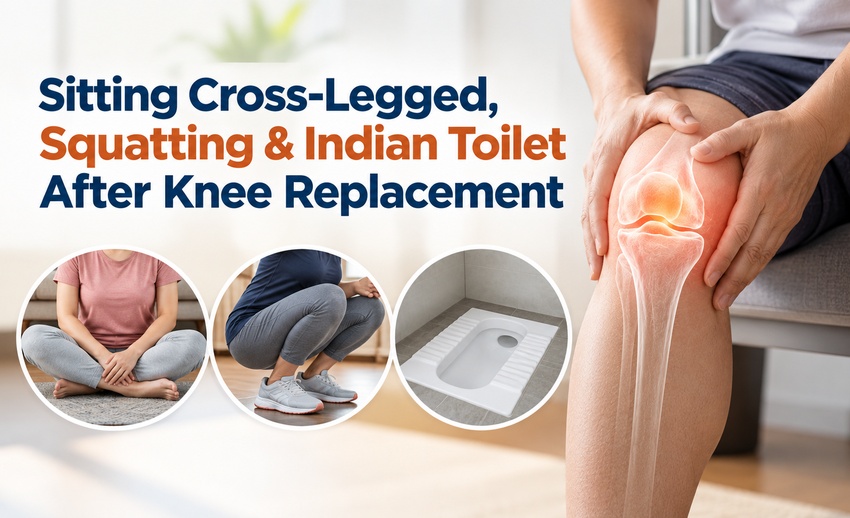
Sitting Cross-Legged, Squatting & Indian Toilet After Knee Replacement
Knee replacement can significantly improve mobility, reduce pain and help people return to everyday activities. However, many Indian patients have a common question after surgery: Can I sit cross-legged, squat, sit on the floor or use an Indian-style toilet again? These activities require considerable knee bending, and recovery differs from one person to another. Research in Indian patients has shown that deep knee flexion is not essential for satisfaction after knee replacement, although some patients may regain the ability to perform high-flexion activities.
The key is not to force the knee into a position before it is ready. A structured rehabilitation programme, regular exercises and gradual improvement in range of motion can help you regain functional movement safely.
Sitting Cross-Legged After Knee Replacement
Sitting cross legged after knee replacement requires substantial knee and hip flexibility. Whether you can comfortably return to this position depends on factors such as your pre-surgery range of motion, muscle strength, implant and individual healing.
Some patients may eventually sit cross-legged, while others may find it uncomfortable or may not regain sufficient flexion. Studies of Indian patients have found that many remained satisfied with their knee replacement even without being able to squat or sit cross-legged.
Do not repeatedly push your knee into deep flexion simply to achieve this position. Your orthopaedic surgeon or physiotherapist can assess whether your knee has sufficient movement for it.
Squatting After Knee Replacement
Squatting after knee replacement is one of the more demanding movements because it places the knee in deep flexion. Different squat depths require different amounts of knee movement. One study found average knee flexion of approximately 116° during parallel squats and 133° during deep squats in patients who could perform these positions after TKA.
If squatting is important for your lifestyle, rehabilitation should focus on gradually improving:
- Knee flexion and extension
- Quadriceps and hamstring strength
- Balance and stability
- Hip and ankle mobility
- Functional movements such as sit-to-stand
Start with movements recommended by your rehabilitation team rather than attempting a deep squat immediately.
Can You Use an Indian Toilet After Knee Replacement?
An Indian-style toilet requires deep squatting and therefore considerable knee flexion. For this reason, using it soon after surgery can be difficult and may not be appropriate for everyone.
During the early recovery period, a raised or Western-style toilet can make bathroom use easier and reduce the need for deep bending. AAOS also recommends preparing the bathroom with appropriate aids, including a raised toilet seat when needed, during the initial recovery period.
Whether you can eventually use an Indian toilet depends on your range of motion, strength, balance and your surgeon’s assessment. Never use deep squatting as a test of recovery.
Sitting on the Floor After Knee Replacement
Sitting on floor after knee replacement may be possible for some patients but difficult for others. Floor sitting often involves a combination of deep knee bending, hip rotation and controlled movement while getting down and standing back up.
For religious activities, family gatherings or meals, consider temporary alternatives such as:
- Sitting on a firm, elevated chair
- Using a supportive cushion
- Choosing a higher seating arrangement
- Avoiding positions that cause pain or instability
Your ability to perform everyday activities should improve progressively. AAOS notes that rehabilitation exercises help restore movement and strengthen the joint following replacement.
Knee Bending Exercises After Knee Replacement
Knee bending exercises after knee replacement are an important part of rehabilitation. Your physiotherapist may prescribe movements based on your individual condition rather than following a fixed exercise routine.
Common rehabilitation goals include:
- Improving knee flexion gradually.
- Regaining full or near-full knee extension.
- Strengthening the quadriceps and surrounding muscles.
- Improving walking, balance and functional movement.
- Progressing from basic exercises to more demanding activities.
AAOS rehabilitation guidance includes exercises such as controlled half squats and hamstring curls, although the appropriate exercise and progression should be individualised.
Similarly, knee bending exercises after surgery should not be performed aggressively. Pain, swelling or unusual instability should be discussed with your treating team.
What Determines Your Ability to Bend the Knee?
There is no single timeline that applies to every patient. Your eventual movement can be influenced by:
- Preoperative knee flexibility
- Muscle strength
- Rehabilitation consistency
- Swelling and pain
- Overall healing
- Surgical and implant-related factors
- Individual anatomy and lifestyle requirements
Therefore, compare your progress with your own recovery plan rather than another patient’s results.
Conclusion
Sitting cross legged after knee replacement, squatting, floor sitting and using an Indian toilet are possible for some patients but are not guaranteed after surgery. These activities demand substantial knee flexion, and attempting them too early can interfere with comfortable recovery. Focus first on pain control, mobility, strength and prescribed rehabilitation. With appropriate knee bending exercises after knee replacement, many patients can progressively improve their functional movement. Dr Abhijit Tayade can assess your individual recovery and guide you regarding realistic activity goals after knee replacement.
Want personalised guidance about knee replacement recovery and mobility? Consult Dr Abhijit Tayade to understand the rehabilitation approach suited to your knee and daily activities.
Frequently Asked Questions
Can I sit cross-legged after knee replacement?
Some patients can eventually sit cross-legged, while others cannot achieve sufficient flexion comfortably. Your preoperative flexibility, rehabilitation and individual recovery influence the outcome. Do not force the position without discussing it with your orthopaedic surgeon.
Can I use an Indian-style toilet after knee replacement?
An Indian toilet requires deep squatting and substantial knee flexion. It may not be suitable during early recovery. A raised or Western-style toilet can be a safer temporary option until your surgeon confirms that deep squatting is appropriate.
Can I sit on the floor for prayers or family functions?
Floor sitting may become possible depending on your knee flexibility, strength and recovery. Initially, consider elevated seating or a supportive chair. Your surgeon or physiotherapist can advise when and whether floor sitting is appropriate for you.
How can I improve knee bending after surgery?
Follow your prescribed rehabilitation programme consistently. Physiotherapy, appropriate stretching, strengthening and gradual range-of-motion exercises can help improve movement. Avoid forceful bending or exercises that cause significant pain or swelling.