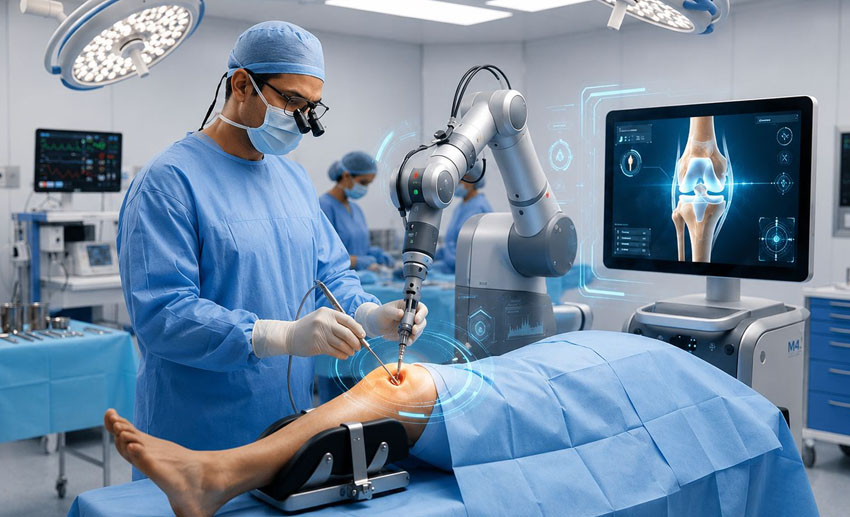
Types of Robotic Knee Replacement | Pros, Recovery & Cost
One example of a recent technological development in orthopedic care that enhances precision and results in joint replacement surgery is robot knee replacement. It is a product that integrates surgical skills with robotics to assist patients in being more aligned and to recover quickly. To the individuals involved in the field of seeking treatment, it is important to know the types of treatment, their benefits, and their recovery process.
Definition of Robotic Knee Replacement?
Robotic knee replacement is a surgical procedure performed with high accuracy using a robotic system that assists the surgeon in planning and carrying out the surgery. It does not take the place of the surgeon but makes him or her better at making perfect cuts and putting the implant in place. This is the practice that is mostly addressed by an orthopedic knee specialist to patients who have severe arthritis or are damaged.
Robotic Knee Replacement Types
1. Total Knee Replacement (TKR)
This is done by removing the entire knee joint and inserting a synthetic implant. Accurate alignment is achieved with the help of the robots, and this can enhance the life of the implant.
2. Partial Knee Replacement (PKR)
Only the damaged part of the knee is substituted. This is appropriate where patients have a low level of damage in the joints and recovery is made faster.
3. Knee Replacement with Robotic Assistance
It is done when a knee replacement that was placed earlier fails or wears out. The robotic system assists in the correction of alignment and enhancement of the positioning of the implants.
Advantages of Robotic Knee Replacement
- Increased Precision: Robotic systems are able to offer 3D imaging and real time guidance, which minimises errors.
- Minimal Trauma and Pain: Smaller incisions and tissue damage result in the existence of fewer post-operative pain.
- Quick Recovery: Numerous patients are able to resume their daily routine at an earlier time than conventional means.
- Enhanced Implant Survival: Precise implantation leads to enhanced joint stability.
- Enhanced Functionality: Patients tend to move and stand in a better way.
These are the benefits that make it a choice whenever seeking the services of the most qualified surgeon for knee replacement surgery in Delhi or any similar specialist.
After Robotic Knee Replacement.
There is no standard recovery timeline, as recovery depends on the severity of the injury; however, most patients begin walking with some assistance within 24-48 hours. Physical therapy is an important measure to restore strength and mobility.
- First 2 Weeks: Relaxation of pain and light exercises.
- 3-6 Weeks: Movement and slow recovery of normal functioning.
- 6-12 Weeks: Great improvement in recovery, more normal joint functioning.
To make the recovery process effective and smooth, it is possible to follow the recommendation of a leading knee replacement surgeon in Delhi.
Price of Robotic Knee Replacement
In India, the cost of a robotic knee replacement is usually between Rs. 2.5 lakh and Rs. 5 lakh per knee. The cost-impacting factors would be the facilities of the hospital, the experience of the surgeon, the type of implant, and the technology applied. The selection of the most appropriate knee replacement hospital in Delhi tends to provide the opportunity to have high-tech treatment and complex care.
Conclusion
The orthopedic surgery has taken a new turn with robotic knee replacement because it is more precise, recovers faster and has long term results which are better. This is a great choice for patients who want to receive high-level and quality treatment for knee joint problems.
To the readers who may be contemplating such a procedure, a skilled specialist such as Dr. Abhijit Tayade can be of help and offer the correct direction and individualized form of treatment depending on the demands of the patient.